Choosing
Chalk Board or White Board in an Indian Classroom: How to Decide
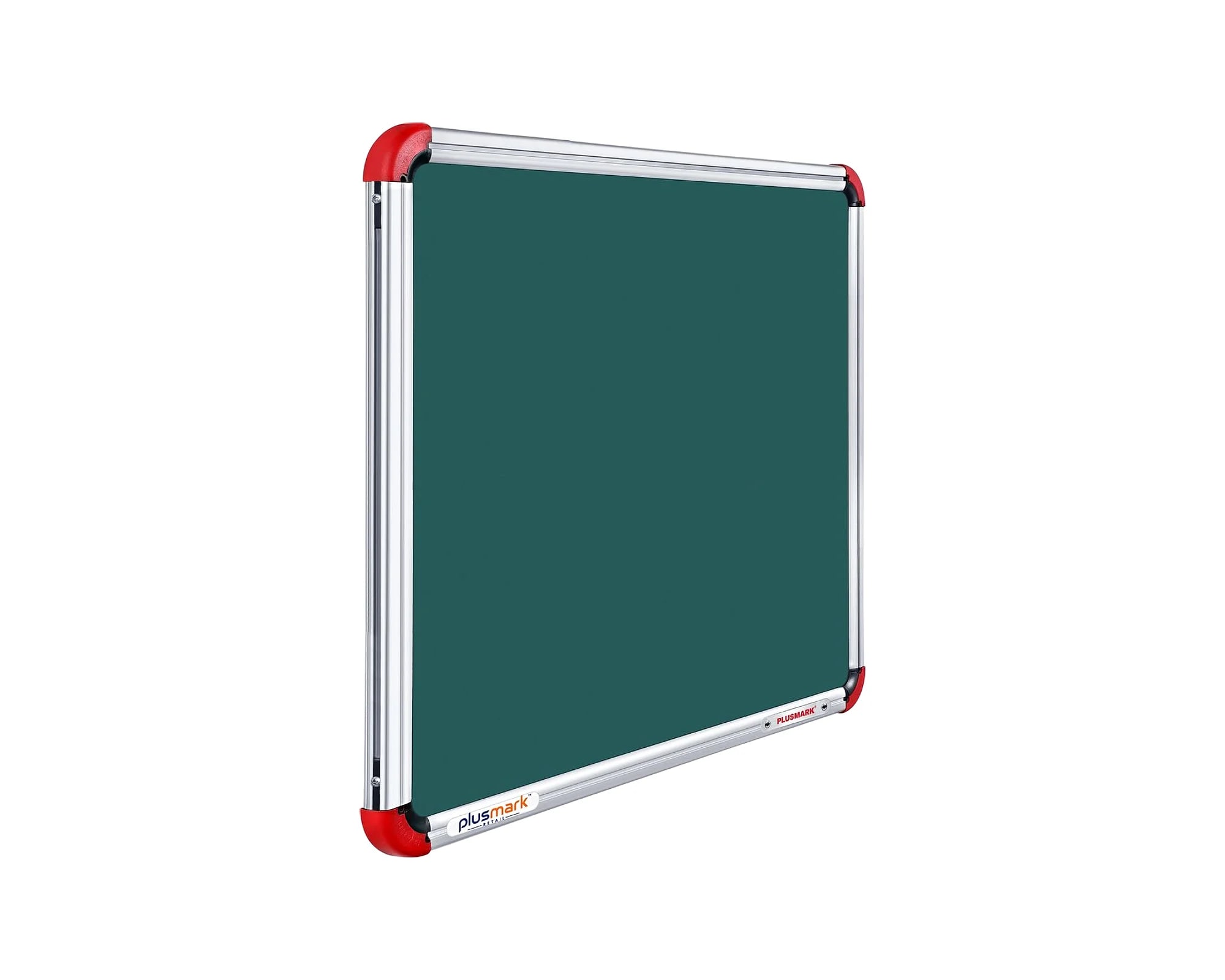
The chalk-versus-marker question is usually framed as old against new. In practice it is about how the room is taught in and how much light falls on the wall.
Plusmark manufactures both, in the same four construction series, which is the clearest sign that the right answer is per-room rather than per-school.
Where chalk boards win
Chalk Grade HPL is non-reflective and glare-free, which is why it stays readable from the sides and the back of a deep room. Chalk is also faster for long, continuous writing — mathematics, derivations, board-work that runs through a whole period — because a marker board of the same size starts to look exhausted halfway through.
The Hardcore Chalk Grade variant adds scratch resistance, which matters because chalk is abrasive in a way marker ink is not.
Where white boards win
Marker boards are cleaner to maintain in a room where dust is a problem — ground-floor classrooms, rooms near construction, and any space shared with young students. High Gloss Marker Grade HPL takes colour, and colour is genuinely useful for separating steps in a solution, marking corrections or diagramming.
Magnetic marker boards add display: charts, answer keys and maps go up beside the working area without a separate notice board on the wall.
The decision, room by room
A working rule that holds up across schools.
| Room condition | Choose |
|---|---|
| Deep hall, back rows, side viewing angles | Chalk board — non-reflective, glare-free |
| Long continuous writing, maths and derivations | Chalk board |
| Dust-sensitive rooms, younger students | White board |
| Colour-coded teaching, diagrams, corrections | White board |
| Charts and rosters displayed alongside writing | Magnetic white board |
| Board written on and erased all day | Ceramic surface, white or chalk |
Both, in one building, without it looking mismatched
Because chalk and white boards are each produced across Metallic Premium, Eco Premium, Deluxe Standard and Eco Regular, a school can standardise on one series for frame and corner appearance while mixing surfaces by room. Chalk boards also come magnetic and non-magnetic, and in both white and green finishes.
Double-sided boards go one step further — a writing surface on each face — which is how a shared room or a staff room keeps two uses of one wall.
Questions on this topic
- Is a chalk board cheaper than a white board?
- Not necessarily, and prices are not published for either. The two are built in the same four series, so a chalk board and a marker board of the same series and size are comparable specifications. What changes the number is the surface grade and the framing, which is why the comparison is worth running room by room.
- Should a dusty classroom switch from chalk to marker?
- Dust is a reason to look carefully, but it is a maintenance question before it is a surface question. Chalk dust builds up when a board is only dry-erased and never washed. If the room cannot take a weekly wash, a marker board is the practical answer; if it can, a chalk board stays perfectly serviceable.
- Can a school run chalk in some rooms and markers in others?
- Yes, and that is the normal way to specify a building. Surfaces are chosen per room while the series is held constant, so frames, corners and finishes stay consistent even when the writing medium changes from classroom to classroom.
- Which surface suits a lecture hall used all day?
- Ceramic steel, in whichever medium the faculty writes with. It is the one surface in the range listed for continuous writing and frequent cleaning, and it accepts magnets, so charts go up beside the working area.
Boards mentioned in this guide
Sizes, surfaces and frame variants listed here are made to order. Send Plusmark your room details and quantity and the team will confirm what is available in that series.