Choosing
A Board at Home: Sizing the Study Corner, Homework Table and Practice Setup
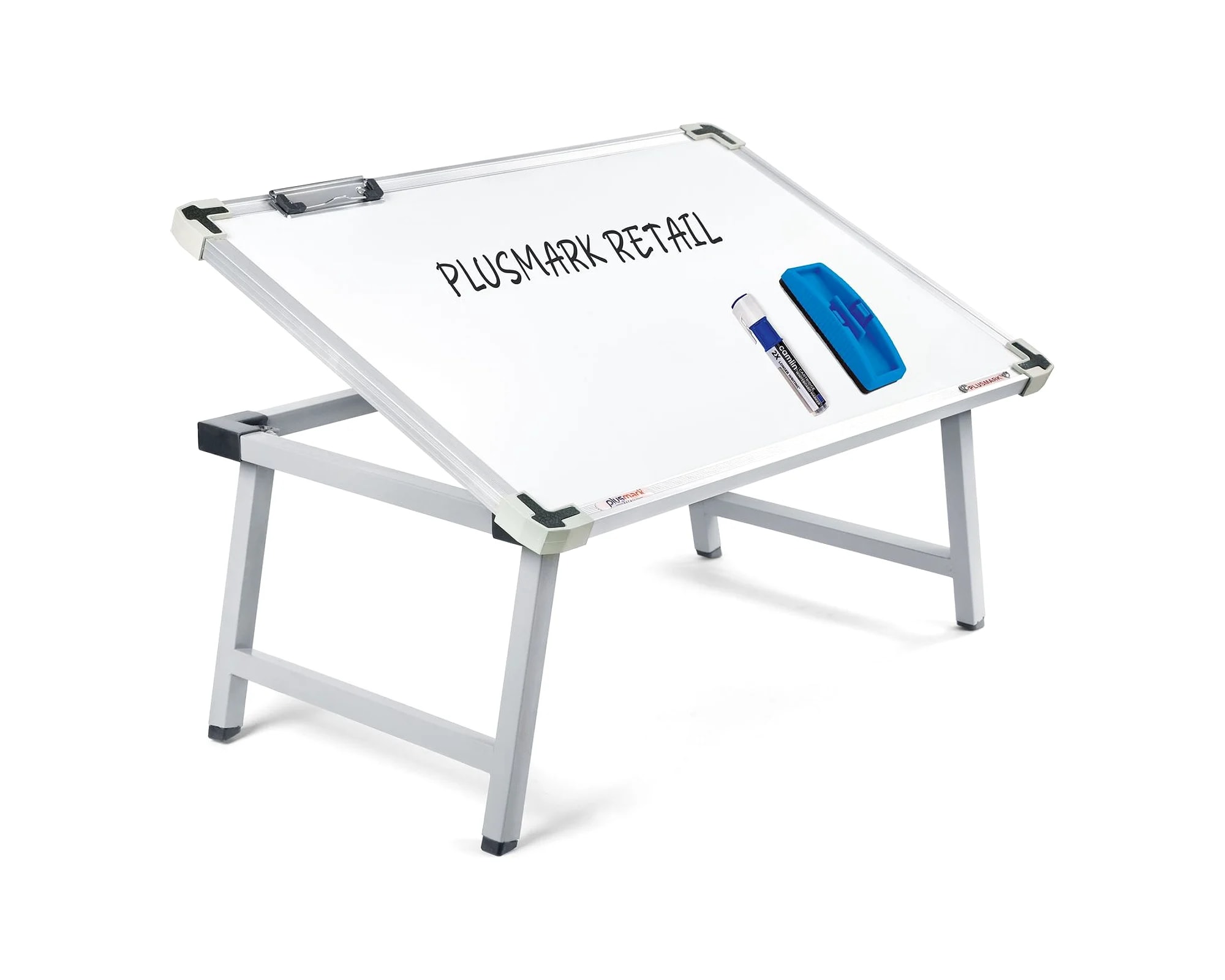
A board in a house does a different job from a board in a classroom. Nobody writes a lesson on it; a child works through sums on it, a parent writes a list on it, and it has to survive being used by someone half the height of the person who hung it.
That changes three decisions: how small you can safely go, whether the surface should take marker or chalk, and whether the board should be on the wall at all. Plusmark's small-format boards, double-sided boards, homework tables and handwriting practice boards are the four products that answer a home study corner.
Start with the smallest size that still works
Home walls are narrow and full of doors, shelves and switches, so the constraint is rarely budget. The catalog's small end starts at 1 × 1 ft desk boards, with Eco Premium and Eco Regular available from 1.5 × 2 ft — sizes that fit a corner by a study chair without dominating the room.
For a child working through practice sums, 1.5 × 2 ft is usually the comfortable floor: it holds a line of four or five short problems and still wipes in seconds. Anything larger in a bedroom tends to become a display surface rather than a working one.
Marker or chalk, decided by the child
Marker needs a board and a marker. Chalk needs a board, chalk, and somewhere to brush off the dust — which is the real argument against chalk in a bedroom and the real argument for it in a utility area or a covered balcony.
If the household genuinely uses both, a double-sided board is the space-saving answer: a white board surface on the front for marker and a chalk board on the back, in one aluminium frame. It can be hung either way round, and one wall carries both writing methods.
A homework table instead of a wall board
Where drilling is not an option — a rented house, a shared room, a wall already covered — the Homework Table is the other shape of the same idea. It is a foldable table with a 16 × 24 inch white board writing surface and a 9.5 inch working height, so the child writes on the surface in front of them and the whole thing folds away after study time.
It also fixes the height problem a wall board creates in a mixed-use house: an adult hangs a board at adult height, and it stops working for the child within six months.
Handwriting years need lined boards, not blank ones
For early writing, a blank surface is the wrong tool. Plusmark's Four Line and Square Line Practice Boards carry the line marking a child actually needs for letter formation, and the line layout is provided as per school or customer requirement — so the practice board at home can match the one in the classroom rather than fight it.
Letters and figures sets complete the same corner. The sets are listed at 112 pieces for letters and 100 for figures, in 12 mm, 18 mm, 24 mm and 36 mm sizes, so a magnetic board becomes a spelling and number work surface rather than only a writing one.
Magnetic or not, and how to hang it
Magnetism is fixed at manufacture — a non-magnetic board cannot be converted later — so if charts, timetables or a term calendar are going to live on the surface, order the magnetic version now. If the surface is only ever written on and wiped, non-magnetic does the same job and the money is better spent on size.
Framed boards are supplied for wall mounting and can be hung horizontally or vertically, which is what makes a narrow strip of wall by a study chair usable. If nothing can be drilled, a board stand holds the same board and moves it out of the way at the end of the day.
What to send when you order
The size, the surface (marker or chalk, magnetic or non-magnetic), the room it is going into, and whether it is going on a wall or standing. Sizes, framing and what is supplied with the board are confirmed per order, so a one-line room description is worth more than a bare size.
Questions on this topic
- What size white board is enough for a child's study corner?
- Between 1 × 1 ft and 2 × 3 ft covers most homes. Around 1.5 × 2 ft is the practical minimum for working through a few sums at a time, and anything larger than 2 × 3 ft in a bedroom usually turns into a display board.
- Is there an alternative to mounting a board on the wall?
- Yes, two of them. The Homework Table is a foldable table with a 16 × 24 inch white board surface at 9.5 inches working height, and board stands hold a framed board without any drilling at all.
- Should I buy a magnetic board for home?
- Only if something is going to be stuck on it. Magnets are built into the resin coated steel surface at manufacture and cannot be added later, so a board meant purely for writing and wiping is better served by a non-magnetic surface at a larger size.
Boards mentioned in this guide
Sizes, surfaces and frame variants listed here are made to order. Send Plusmark your room details and quantity and the team will confirm what is available in that series.