Products
Combination Boards: One Writing Surface and One Pin-Up Surface in the Same Frame
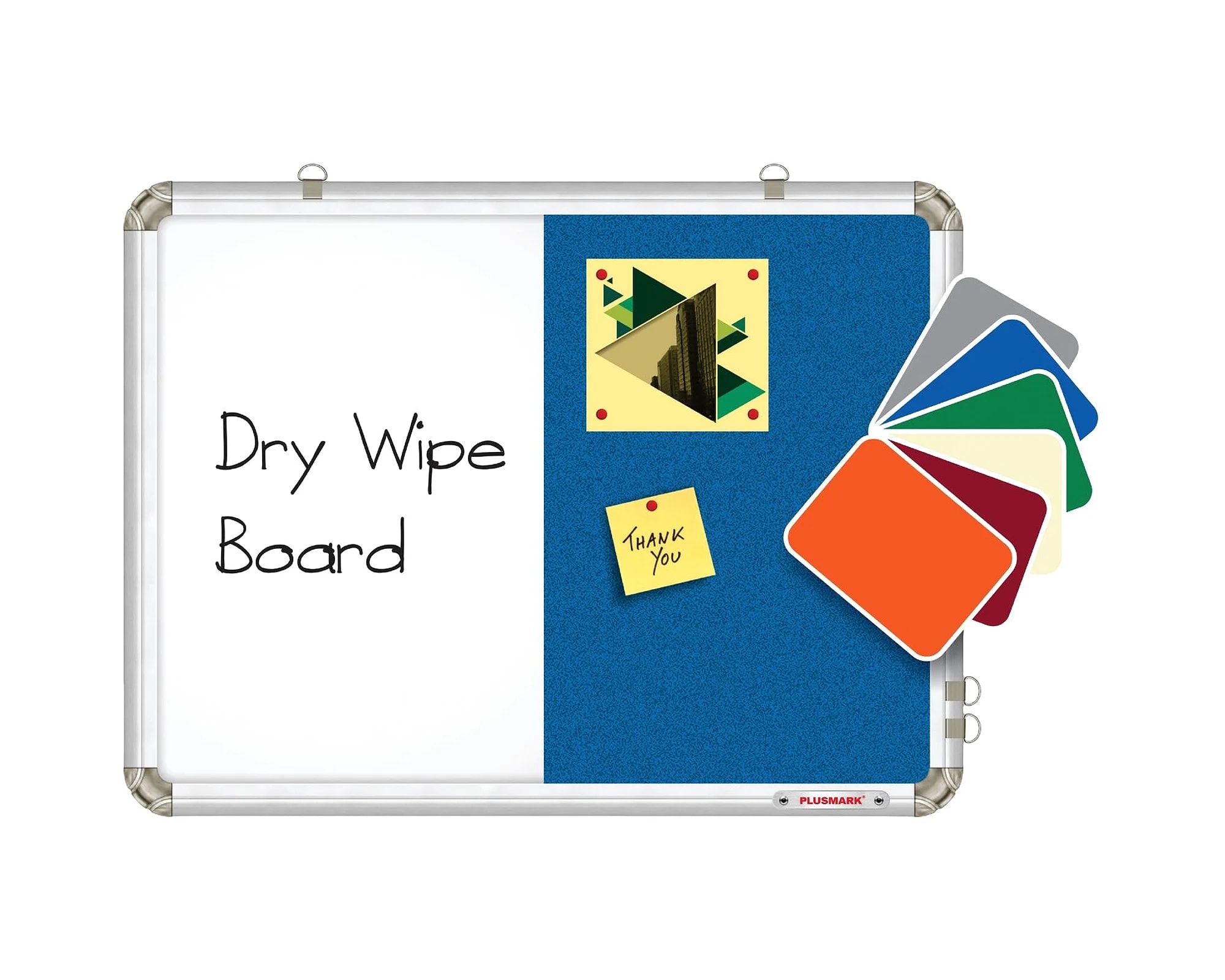
Notice boards and white boards answer different questions. A notice board holds paper that has to stay readable for a fortnight; a white board holds writing that gets wiped out the same afternoon. Rooms that need both usually end up with two frames side by side on one wall, which is exactly the situation the Combination Board exists to avoid.
The catalog describes it plainly: a dry wipe white board on one side and a fabric notice board on the other, so marker writing and pin-up display happen on a single board. This guide covers how that differs from a double-sided board, which rooms it suits, and what to specify.
What the board actually is
One framed panel, two working faces. The white face is a dry wipe surface — the catalog lists smooth marker writing with easy erase. The other face is fabric, listed as suitable for repeated pin use, with frequent pinning and removal possible without surface damage or loss of grip.
So a circular can stay pinned for two weeks while the same board carries a timetable that gets rewritten every morning. Neither job has to wait for the other, and neither surface has to be cleared to make room for the second.
How it differs from a double-sided board
Both are two-face boards, and buyers mix them up constantly. A double-sided board gives you two writing surfaces — the range pairs marker on one side with chalk on the other, which is a decision about the writing medium. A combination board gives you one writing surface and one display surface, which is a decision about what the wall has to do.
The test is simple. If the second face exists so a different pen or chalk can be used, that is a double-sided board. If the second face exists to hold paper, photographs and notices with pins, it is a combination board.
The problem it solves is wall space, not cost
Institutions do not usually buy a combination board to save money; they buy it when the wall is already spoken for. A staff room corridor with one clear stretch between a door and a switchboard cannot take two frames at readable height. A reception that must show announcements and take a quick written note has the same constraint.
There is a second, quieter benefit: one fixing, one frame line, one visual object on the wall. Where a corridor has five boards of two different builds, the room starts to look like a storeroom. Combining the two functions into one frame keeps the wall legible to people reading it.
Which frame it comes in
The catalog lists the combination board in the same three frame variants as the rest of the notice board range — Metallic Premium, Eco Premium and Deluxe — so the build grade is chosen the same way it is for a cloth board. Corners and framing are a separate decision from surface mix, and the series guide explains what each grade is built for.
The fabric side also inherits the notice board customisation habit: fabric notice boards are listed in the customer's preferred fabric colour with layout provided as per requirement. If the room has a colour scheme or the institution has a brand colour, ask whether the same applies to the combination build for your size.
Where it fits, and where it does not
It fits where the two jobs are genuinely both daily: an office notice wall with a meeting-room overflow, a coaching centre corridor that posts batches and takes corrections, a factory entrance board that carries the day's numbers alongside pinned work instructions, a hostel reception, a clinic waiting area, a department staff room.
- Good fit: pinned notices change weekly and writing happens daily.
- Good fit: only one clear stretch of wall is available at readable height.
- Poor fit: the room writes on both media all day — that is a double-sided board.
- Poor fit: the notices must be protected or secured — a lockable acrylic door cover board is the right product.
- Poor fit: the pinned side needs to show large charts — a plain cloth or cork board of a bigger size serves better.
How to specify one
Send four things: which face does which job, the size, the frame variant, and the room it is going into. If the fabric colour matters, say so in the same line. Quantity matters more than it looks, because a combination board replaces a pair — a building list written as one line per wall is easier to price and easier to install than a mixed list of single-function boards.
Orientation is worth asking about rather than assuming. The white face and the fabric face read differently at different heights, and the sales team can confirm which way the board you are ordering is meant to hang.
Questions on this topic
- Is a combination board the same as a double-sided board?
- No. A double-sided board carries two writing surfaces — typically marker on one face and chalk on the other. A combination board carries one dry wipe writing face and one fabric pin-up face, so it writes and displays rather than writes twice.
- Can the fabric side be ordered in our colour?
- Fabric notice boards are listed in the customer's preferred fabric colour with the layout provided as per requirement. For a combination board, confirm with the sales team whether the same colour and layout option applies to the size you are ordering.
- Can I pin on the white board side?
- No. The white face is a dry wipe writing surface, and pins go into the fabric face. If you need magnets as well as pins, that is a different specification — magnetic boards use resin coated steel surfaces, which are listed as accepting magnets.
Boards mentioned in this guide
Sizes, surfaces and frame variants listed here are made to order. Send Plusmark your room details and quantity and the team will confirm what is available in that series.