Buying
Comparing Two Board Quotes: The Line-by-Line Checklist
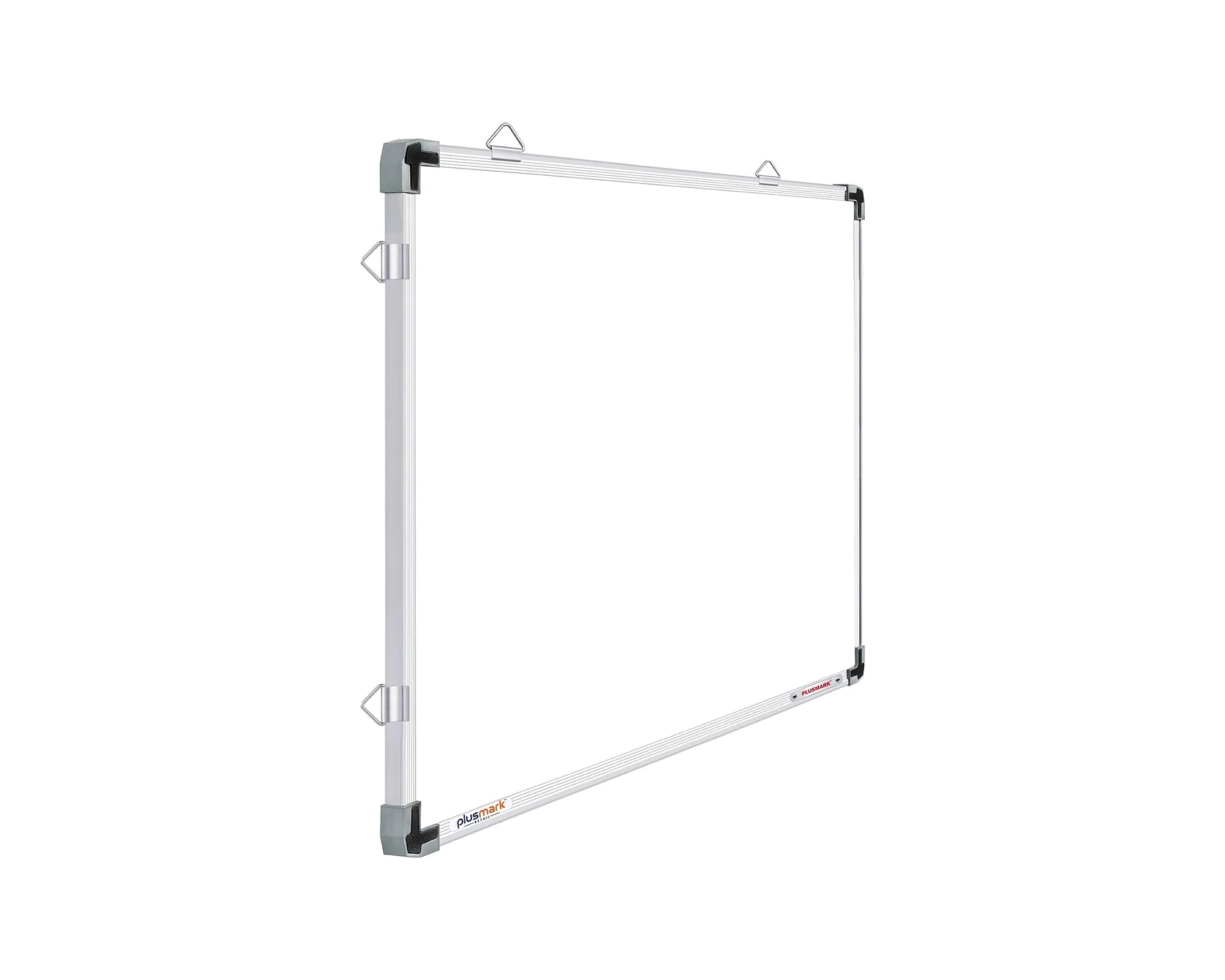
Ask for boards for a building and you will usually get two proposals that both say 3 × 4 white board, and a price difference that looks unreasonable. Most of the time neither quote is wrong — they are describing different products in the same words, because a board is priced by its surface, its framing, its size and its mounting, and only one of those four is the size.
This is a checklist for reading two proposals side by side. It is deliberately not about who is cheaper.
Line 1: the surface, by name
The surface is the part that gets written on and the part that has to be replaced, so it is the first thing to pin down. Plusmark's documented surfaces are High Gloss Marker Grade HPL, Hardcore and Chalk Grade HPL, resin coated steel, ceramic steel / porcelain enamel steel, 2 mm Blazer Cloth, Super Fine Velvet Cloth and natural cork.
A quote that says white board and nothing else is incomplete rather than cheap. Ask for the surface name in writing, then compare that name between proposals. The six-surface guide explains what each is for, and the surface comparison guide covers when porcelain enamel is worth it and when it is overkill.
Line 2: the series, which is the framing
The same surface comes in four build grades, and the grade is what the frame, corners and core are made of. That is the entire difference between four boards of identical size.
| Series | What the catalog says | Read this as |
|---|---|---|
| Metallic Premium | Heavy-duty aluminium framing, Signature Dual-Tone Corners, intensive daily institutional use | The top build — corridors, auditoria, heavy-use classrooms |
| Eco Premium | Premium-grade materials, ABS Dual-Tone Corner Design, reliable for daily institutional use | Strong everyday institutional build |
| Deluxe Standard | Aluminium framing with Electroplated Chrome Corners, dependable for everyday use | Balanced specification |
| Eco Regular | Cost-effective materials, lightweight frame, standard plastic corners, light and occasional use | Budget build for genuinely light use |
Line 3: the size, and whether that size exists
Sizes in the range run from small 1 × 1 ft desk boards up to 8 × 4 ft, but not every series makes every size. The catalog states Metallic Premium and Deluxe Standard boards are made from 3 × 4 ft up to 8 × 4 ft, and Eco Premium and Eco Regular from 1.5 × 2 ft up to 8 × 4 ft, with larger or non-standard sizes made to order.
That gives you a fast sanity check on a proposal. A Metallic Premium board quoted at 2 × 2 ft is either a mistake or a made-to-order item, and you should know which before comparing it to an Eco Premium board of the same size. The size chart lists the standard sizes in feet and centimetres, including the 90 × 120 cm way buyers often write 3 × 4 ft.
Line 4: magnetic or not
Magnets are a property of the surface, not an accessory. Resin coated steel and ceramic steel surfaces are listed as accepting magnets and magnetic accessories; High Gloss Marker Grade HPL surfaces are listed as non-magnetic. A board cannot be made magnetic later, so a quote that does not state which you are getting has quietly made the decision for you.
Worth checking honestly, too. If nothing will be stuck to the board, paying for magnetic is waste. If charts will go up on the wall beside the writing, non-magnetic means a second surface somewhere else in the room.
Line 5: mounting, and what the site is ready for
Wall-mounted or on a stand is part of the specification, not an afterthought, and it changes what has to be bought and who has to be on site. Boards listed as wall-mountable are fixed with a quick installation; stands are separate line items, sized against the board.
So compare the mounting line before the money. One proposal that includes stands and one that assumes a drilled wall are not quoting the same job, and the one with the lower number may be the one that leaves you without a base.
What the quotes leave out
Four things go missing regularly, and all four cost more than the line items they replace.
- Custom design work. When Plusmark makes the design of a board rather than reproducing a sketch, additional charges apply — so a schedule board quote should say whose design it is.
- Non-standard sizes, which are made to order rather than picked from the standard list.
- Quantity by room. A per-building total hides the fact that two rooms need 2 × 3 and one needs 4 × 8.
- Prices, lead times, minimum order quantities and warranty terms are confirmed by the sales team against your specification. Compare proposals on the five lines above, then take the remaining differences to a conversation.
The one-page way to run it
Make a grid with one row per room: room, board, surface, size, series, magnetic yes or no, mounted or on a stand, quantity. Fill both proposals into it. Usually the two quotes then agree on six of eight columns and differ on one or two — and those differences are the actual comparison, rather than the price gap you started with.
Where the difference is the series and nothing else, the question is not which is cheaper but which room the board is going into. Cheap is correct for a staff room board used monthly. Cheap is expensive on a wall written on by six batches a day.
Questions on this topic
- Two quotes for the same size differ a lot in price. Why?
- Almost always because of the surface and the series rather than the size. The same 3 × 4 ft board can be non-magnetic HPL, magnetic resin coated steel or porcelain enamel, in four different frame grades with different corners and cores. Put both proposals against the five-line checklist and the gap usually explains itself.
- Should a quote name the surface?
- Yes. Ask for the surface in writing — Marker Grade HPL, Chalk Grade HPL, resin coated steel, ceramic steel, Blazer Cloth, velvet or cork. It is the part that wears out, so it is the line that decides what a replacement costs years later.
- Are Plusmark board prices published?
- No. Prices, lead times, minimum order quantities and warranty terms are confirmed by the sales team against the size, surface and configuration you specify, which is why comparing two proposals on specification first is the useful order of work.
Boards mentioned in this guide
Sizes, surfaces and frame variants listed here are made to order. Send Plusmark your room details and quantity and the team will confirm what is available in that series.