Installation
No-Drill Board Setups: Stands, Rented Rooms and Walls You Are Not Allowed to Open Up
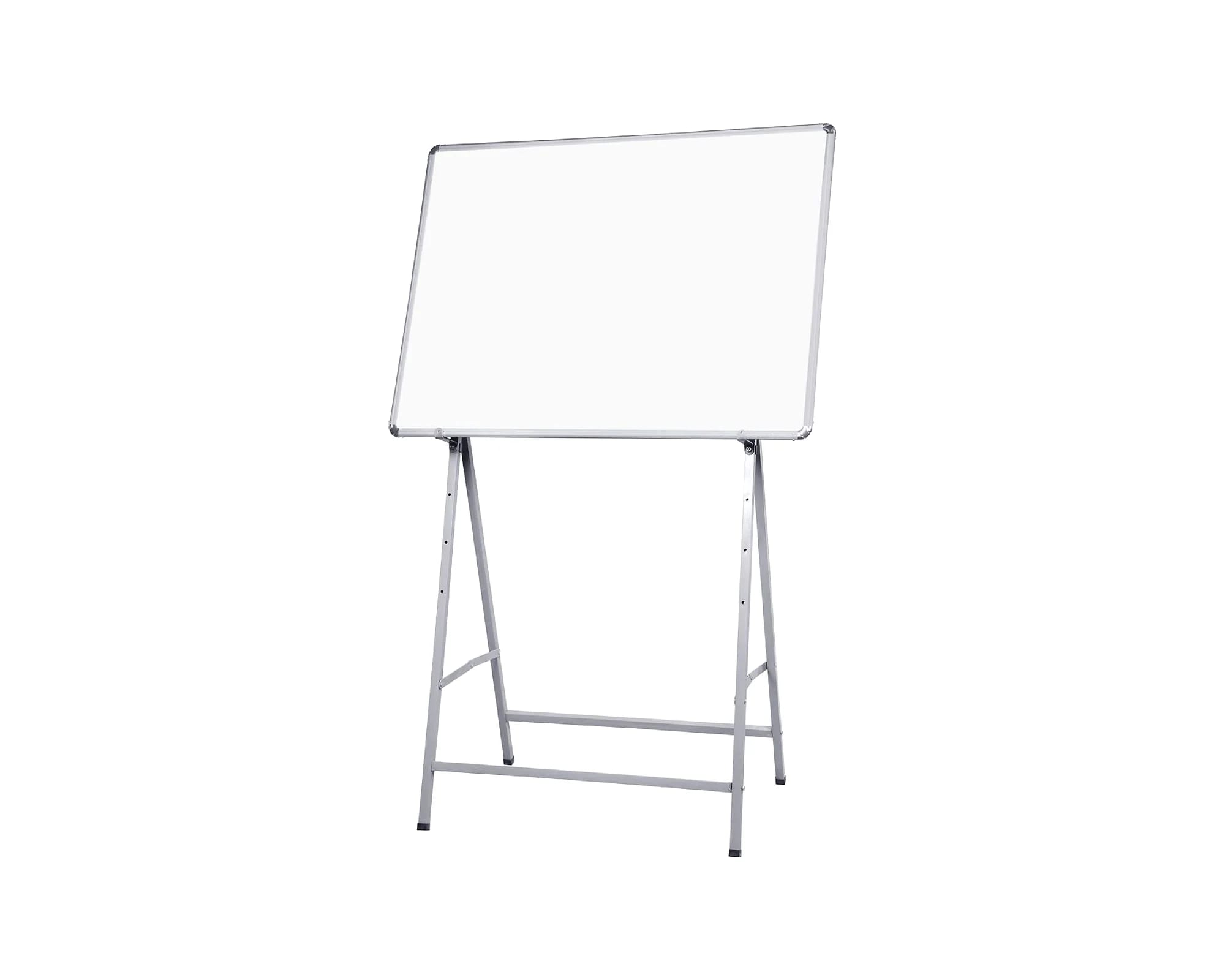
The mounting guide covers how to fix a board to a wall properly. This one is for the other half of reality: walls you are not allowed to open. Rented cabins, coaching rooms where the landlord wants written permission for a single hole, dryboard partitions with nothing behind them, corridors with wiring in the run, and halls that get reconfigured every exam season.
None of those are a reason to skip the board. They are a reason to buy a different configuration, and the range supports it — Plusmark manufactures all types of board stands, listed as three leg, four leg, revolving, zig zag and telescopic.
When drilling is off the table
The common cases are worth naming, because people assume they need a special product when they need a stand and the right size.
- Rented premises, where any hole is a deposit or a written approval.
- Drywall and partition walls with no solid backing at the height you want.
- Heritage, compound or tiled walls where drilling risks a crack.
- Walls with concealed wiring or plumbing in the run.
- Rooms reconfigured between sessions — exam halls, training floors, event space.
- Sites where drilling needs permission from a facility team that is not on site.
A stand is the direct answer
A board stand holds a framed board with no wall work at all, which means the setup is reversible, relocatable and portable when you move out or reshuffle. The five stand shapes cover the different jobs — a light three-point base for a board that travels between rooms, a four-point base for a board that stays put and gets written on hard, a revolving base for two-sided use, a folding zig zag frame for storage between sessions, and a telescopic frame where the height has to change.
The stand guide explains the shapes and how each behaves under a live pen; what matters here is that choosing a stand is not a compromise specification. It is the correct answer when the wall is not yours.
The size limit is real, and it is about the base
A stand is sized against the board that goes on it, not chosen on its own. Institutional board sizes run up to 8 × 4 ft, and a board that large on a freestanding base is a wall decision, not a floor one — a person leaning on a corner of a 8 ft board to reach the top line is going to move the whole thing.
For no-drill setups, the practical band is the smaller standard sizes. Boards from 1 × 1 ft through 3 × 4 ft are the ones that behave well on stands, and the eco range is listed from 1.5 × 2 ft upward, so a 2 × 3 or 3 × 4 on a four leg stand covers most cabins, corridors and small classrooms.
Confirm the stand and the board together with the sales team. A stand quoted against a specific board size is a different conversation from a stand quoted generically.
What to check before the stand arrives
Three things go wrong with freestanding installations, and all three are avoidable with a five-minute look at the room.
- Footprint plus writing clearance. A stand needs the floor area it occupies and space in front of it for the person writing — measure both, not just the wall.
- Floor level. Corridors are sloped for drainage, and a three-point base on a sloped floor will wander. Ask whether the feet adjust before you commit to a shape.
- Who moves it. If a cleaner or a guard has to shift the board weekly, a revolving or telescopic base is the wrong choice and a folding one may be the right one.
Can you go from stand to wall later?
Often yes, but ask at the time of ordering rather than at the time of moving. The board is a framed panel, and whether your size can be put on a wall afterwards depends on the framing and the fixing provision — which is exactly the kind of detail the wall mounting guide walks through. Say in the enquiry if you expect to mount the same board on a wall in a year; it costs nothing to note and can save you buying twice.
If the room is rented permanently and the wall is not yours, the reverse plan is cheaper: buy the stand, keep the board standard, and take both with you.
The cheapest no-drill option is the right size
A lot of no-drill problems are really size problems. A 3 × 4 board is specified for a room that needs a 2 × 3, and then the buyer discovers that the larger board cannot stand safely in the space available. Sizing down is not a loss here: the board gets read from three metres away at most, and a smaller board on a proper base beats a large board leaning against a wall.
The size chart lists every standard size in feet and centimetres, and the room-by-room sizing guide works out what the last row actually needs. Start with those two before you ask for anything custom.
Questions on this topic
- Can a white board be used without drilling the wall?
- Yes. A board stand holds a framed board with no wall work at all, and the range lists five stand shapes — three leg, four leg, revolving, zig zag and telescopic — covering boards that travel, boards that stay put, double-sided boards, and boards that pack away between sessions.
- What is the largest board you can put on a stand?
- It depends on the stand and the board together, so there is no single safe answer. Boards in the smaller standard band up to about 3 × 4 ft behave well freestanding; the largest institutional sizes are wall decisions. Confirm the pairing with the sales team before ordering.
- If we move out, can we take the board with us?
- That is the point of a stand — nothing is fixed to the property, so the board and the base both travel. If you expect to mount the same board on a wall at the next place, say so when you order so the framing question is answered up front.
Boards mentioned in this guide
Sizes, surfaces and frame variants listed here are made to order. Send Plusmark your room details and quantity and the team will confirm what is available in that series.