Installation
How to Mount a White Board on a Wall: Orientation, Height and What to Check First
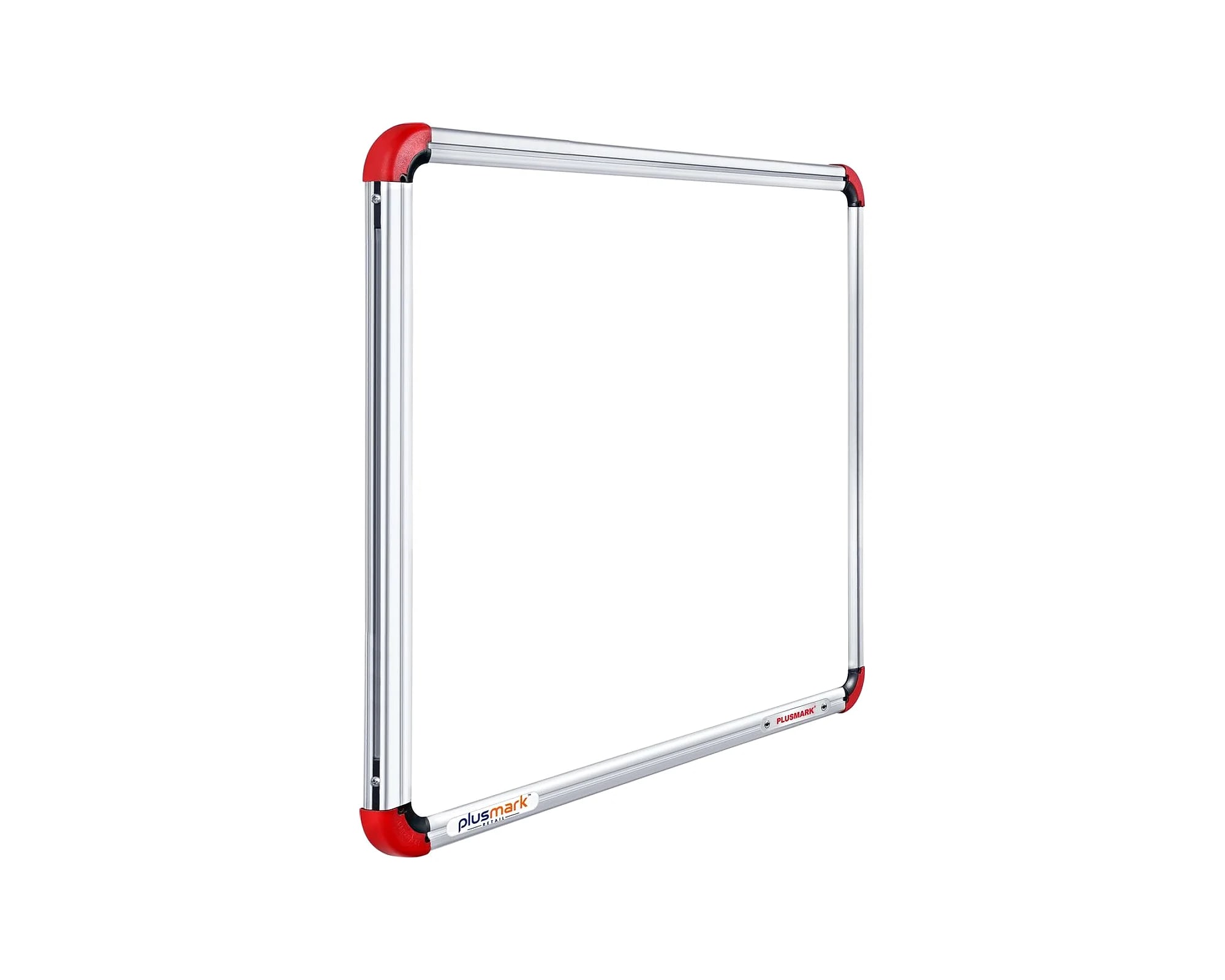
Every framed Plusmark board is built to go straight onto a wall: an aluminium anodised frame with ABS dual-tone edges and quick wall-mount installation, hung horizontally or vertically as the room needs. Nothing about the board requires a specialist fabricator.
What does require attention is everything behind the board — the wall type, the fixings that go into it, the height, and whether the wall is even the right answer. This page covers the checks that decide whether a mounted board is still flat and level in a year.
Check the wall before you check the board
A 3 × 4 ft framed board is a point load carried by two or three fixings, and the wall has to take it. Solid brick and concrete are straightforward. A plasterboard or partition wall needs anchors rated for the load and located at stud positions, or a spread plate behind the board; hanging into hollow plaster alone is what makes boards pull out of the wall within a term.
Damp is the other thing to test. A board on an outside wall above a wet area will trap moisture behind the frame. If the wall has been patched, repainted and re-patched, that pattern is usually the answer.
Set the height for the people writing on it
The rule of thumb is that the top of the writing area should sit at or slightly above the eye line of the tallest regular user, not the average. A board set too high turns into a climbing exercise, and the top third of the surface quietly stops being used — which is the same as having ordered a smaller board.
For a classroom, take the shortest child who will write on it, not the teacher. A 2 × 3 ft board set low with clear wall either side serves a primary class better than a 4 ft board set at adult height.
Standing desks, cabins and meeting rooms are simpler: set the bottom edge above the chair back so someone seated is not writing over a shoulder, and leave the full width reachable from one position.
Horizontal or vertical: the frame allows either
Boards are listed for flexible mounting, so a 3 × 4 ft board can be hung landscape or portrait with no change to the product. That gives you two answers for one wall — a narrow stretch between a window and a door takes the same board portrait that a wide hall wall takes landscape.
Orientation also changes how the room reads the board. Landscape suits a timeline, a roster or a two-column working list. Portrait suits a single flow — an agenda, a numbered procedure, a column of notices.
- Mark the fixing points from the board itself, not from a guess on the wall
- Level the first fixing; a frame that starts out of level stays out of level
- Two people for anything at 4 ft and above — a board twisted mid-lift takes a corner out
- Do not overtighten into the frame; the aluminium and the corner pieces are doing the locating
What to confirm with Plusmark before the fitter arrives
The catalog documents the board, its framing and its wall-mount orientation. It does not list mounting hardware as part of the board itself, so ask what is supplied with your order and what your installation team needs to provide for your wall type. Same question for lead times and for whether the board ships flat against the wall or on a frame that stands off it.
If the wall is unusual — glass, wooden panel, a curved partition, an outside wall — send a photo with the enquiry. It changes the fixing answer, and it is a five-second conversation instead of a repair later.
When a stand is the better answer
Skip the drill entirely if the room is rented, the wall is a partition, the board has to move between halls, or the wall simply is not free. Plusmark lists board stands across three leg, four leg, revolving, zig zag and telescopic types, and a wall-mount-versus-stand decision comes down to permanence and floor space rather than to the board.
Questions on this topic
- Can a Plusmark board be hung vertically?
- Yes. The framed boards are documented for flexible mounting and can be hung horizontally or vertically, which is useful when the wall is tall and narrow rather than wide.
- Is the mounting hardware included with the board?
- Confirm what is supplied with your specific order before installation. The catalog documents the board, its aluminium framing and its wall-mount orientation, but the fixing set for your wall type is something to settle with the sales team.
- How high should a classroom white board be mounted?
- Set the top of the writing area at or slightly above the eye line of the tallest regular user, and make sure the shortest child who writes on it can reach the lower half. A board mounted too high loses its top third, which is the part most often paid for.
Boards mentioned in this guide
Sizes, surfaces and frame variants listed here are made to order. Send Plusmark your room details and quantity and the team will confirm what is available in that series.